
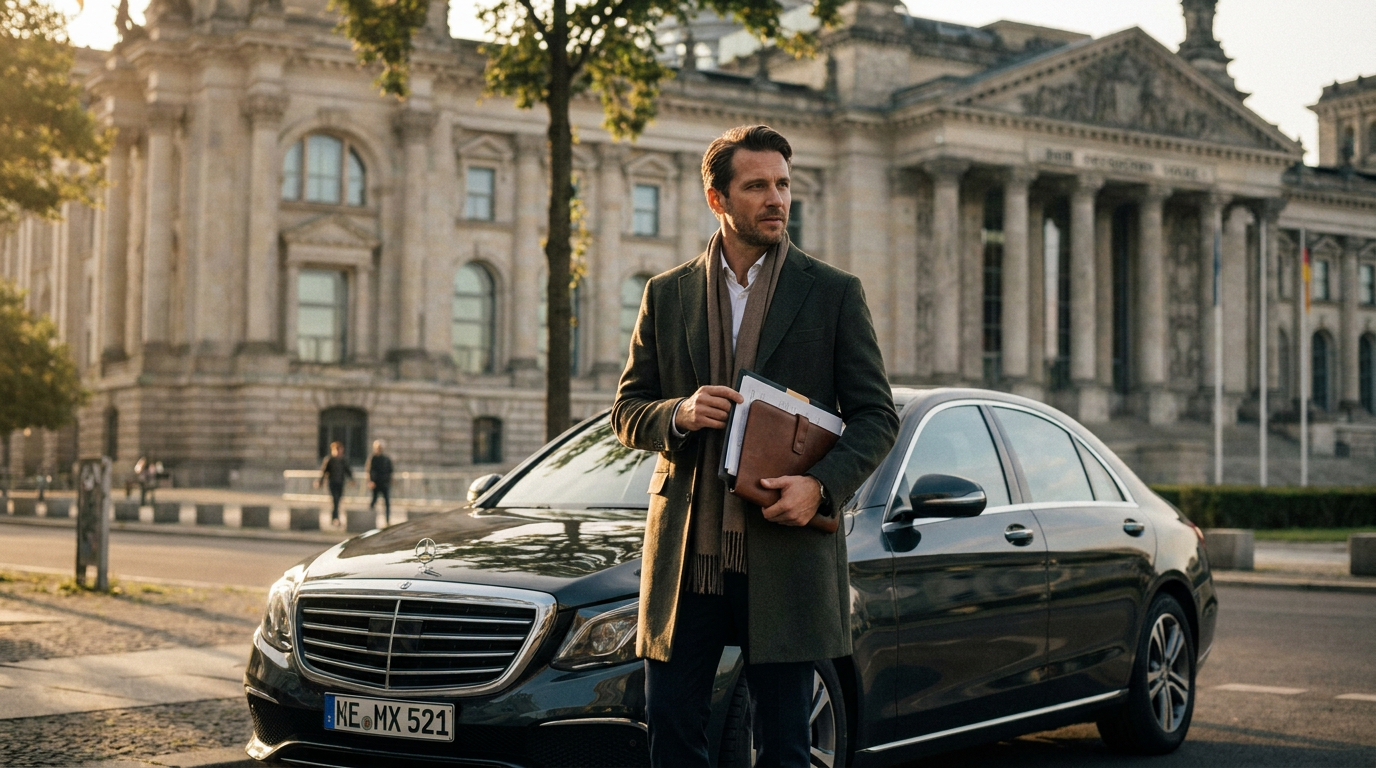

Moving to the German capital brings a wave of administrative tasks. When you move to Berlin, your initial focus is on finding a home and completing your Anmeldung (address registration). But getting around soon becomes a priority. If you hold a foreign driving licence or are bringing your own vehicle to Berlin, you face a complex process: How long is my driving licence valid? When do I need to exchange my driving licence in Berlin? And how do I navigate the process of re-registering my car in Berlin without getting caught in bureaucratic dead ends?
As the founder of YOUR BERLIN, I, Elena Ferrari, work with my team every day to guide private and corporate clients through Berlin’s administrative maze. Time and again, we see how complex and time-consuming these processes are. The requirements of the Landesamt für Bürger- und Ordnungsangelegenheiten (LABO, Berlin’s State Office for Citizens’ and Regulatory Affairs) are precise, and the pitfalls are numerous. Rather than giving you another do-it-yourself guide, we would like to offer a realistic picture of what lies ahead.
Do I need to exchange my driving licence in Berlin?
Whether and when you need to exchange your driving licence depends on your country of origin and the length of your stay in Germany. German driving licence law makes strict distinctions between different groups of countries, which can quickly complicate matters.
1. Driving licences from EU and EEA countries
At first glance, things seem straightforward for holders of a valid driving licence from the EU or the EEA (Iceland, Liechtenstein, Norway). As a rule, your licence remains valid in Germany. But the devil is in the detail. For lorry or bus licences (categories C, D), for example, the shorter German validity periods apply, and medical evidence is required. Many of our clients also choose to exchange their licence voluntarily so that, if the document is lost, stolen or expires, they can handle the administrative work directly in Berlin rather than having to deal with the authorities in their home country.
2. Driving licences from non-EU countries (third countries)
If you come from a country outside the EU/EEA, the clock starts ticking on the day of your Anmeldung in Berlin. You may drive on your home country’s licence for exactly six months. Once this period expires, you are no longer entitled to drive. Continuing to drive then constitutes a criminal offence — driving without a valid licence — with serious legal and insurance consequences. We know from experience that these six months pass more quickly than you expect when you are also juggling work, housing and family. Planning ahead is therefore essential.
3. Countries listed in Anlage 11 FeV and the maze of test requirements
The crucial question is often: Do I need to take another driving test? The answer lies in the bilateral agreements Germany has signed with other countries. If your country of origin is on the so-called “positive list” (Anlage 11 FeV, Annex 11 to the German Driving Licence Regulations), you may be able to exchange your licence without a test or with reduced testing requirements (theory only or practical only). For all other countries, a full theory and practical test through a German driving school is mandatory. Finding out which rule applies to your particular country of origin, or even your US state, is already the first step in a complex research process.
The process at LABO: what to expect
The Landesamt für Bürger- und Ordnungsangelegenheiten (LABO) is responsible for exchanging driving licences. An appointment there is merely the final step in a lengthy preparation process. The list of required documents is extensive, and every single item comes with its own pitfalls.
The challenge of gathering documents
For your application, you must provide the following documents, among others, all complete and correct:
A valid identity document with a current Meldebescheinigung (proof of address registration) — the first hurdle in Berlin
Your original, valid national driving licence
A certified translation of your driving licence — prepared by a sworn translator recognised in Germany. An ordinary translation will be rejected without exception.
A recent biometric passport photograph that meets the German requirements exactly.
An eye test from a recognised provider, no more than two years old.
Proof of attendance at a first aid course whose scope meets German requirements.
We often see clients arrive at their appointment with incomplete or incorrectly prepared documents and get turned away. The result: the entire process starts again, and valuable time within the six-month period is lost.
Registering your car in Berlin: more than just a new number plate
If you bring your own vehicle to Berlin, the law requires you to re-register it at your new address “without delay”. This process at the Kfz-Zulassungsstelle (vehicle registration office) is another prime example of German thoroughness and comes with numerous pitfalls, particularly for imported vehicles.
Documents required for vehicle registration
Here too, the list of documents is long and requires careful preparation. Among other things, you will need:
An identity document and Meldebestätigung (confirmation of address registration)
Zulassungsbescheinigungen Teil I und II (vehicle registration certificates, Parts I and II)
An elektronische Versicherungsbestätigung (electronic insurance confirmation, or eVB number) from a German insurer
Proof of a valid Hauptuntersuchung (HU/TÜV, periodic vehicle roadworthiness inspection)
A SEPA direct debit mandate for vehicle tax — a problem without a German bank account.
For vehicles from abroad, things become particularly complex: CoC documents (Certificate of Conformity) or an expensive full inspection report under § 21 StVZO (German Road Traffic Licensing Regulations) are often required. These terms can be a complete mystery to non-specialists.
The hidden hurdle: the low emission zone
Almost all of central Berlin is a low emission zone. Without the correct green emissions sticker on your windscreen, you risk a fine every time you drive. This sticker is another easily overlooked item on an already long to-do list.
Common pitfalls we see in practice
The real challenges often lie not in the laws themselves, but in putting them into practice.
Appointment availability: Appointments at Berlin’s administrative offices are notoriously scarce and often fully booked weeks or months in advance. This can make meeting the legal deadlines a real source of stress.
Language barriers: All forms, information sheets and communication with case officers are almost exclusively in German. Misunderstandings are almost inevitable and can lead to your application being rejected.
The time involved: Researching the requirements, obtaining all the documents, making repeated trips to administrative offices and testing centres, and waiting on site quickly add up to many hours or even entire working days.
The question many of our clients therefore ask themselves is: Do you really want to invest the valuable time and energy you need for your new job and your new life in Berlin in this bureaucratic marathon?
At YOUR BERLIN, these are precisely the tasks we take care of for you. We know the processes, prepare your documents meticulously and accompany you to appointments. This allows you to focus on what really matters: settling into Berlin. Find out more about our services for private clients or get in touch with us directly.
Frequently asked questions (FAQ)
How long does it take to exchange a driving licence in Berlin?
The overall timeframe is difficult to predict and depends on many factors: appointment availability at LABO, whether your documents are complete, whether tests are required, and the processing times at the Bundesdruckerei (Federal Printing Office) for your new photocard driving licence. The process can take anything from a few weeks to several months or more.
What happens if I miss the six-month deadline for exchanging my licence?
Once the deadline has passed, you may no longer drive a motor vehicle in Germany. If you do so anyway, this counts as driving without a valid licence. This is a criminal offence punishable by a fine or even imprisonment and has serious insurance implications. Your motor third-party liability insurer may refuse to pay out in the event of a claim.
Can I re-register my car without a Meldebescheinigung?
No, officially completing the Anmeldung for your address at the Bürgeramt (citizens’ office) is the basic prerequisite for almost all further administrative steps in Berlin. Without a valid Meldebescheinigung, you cannot register a vehicle, exchange a driving licence or even open a bank account.